05 · Essays

Six arguments, written
for six different judges.

Competition essays test something research alone can't: whether the argument survives a reader who owes me nothing. Same instinct as everything else here — find the gap between what a system claims to do and what it actually does — aimed at six different prompts.

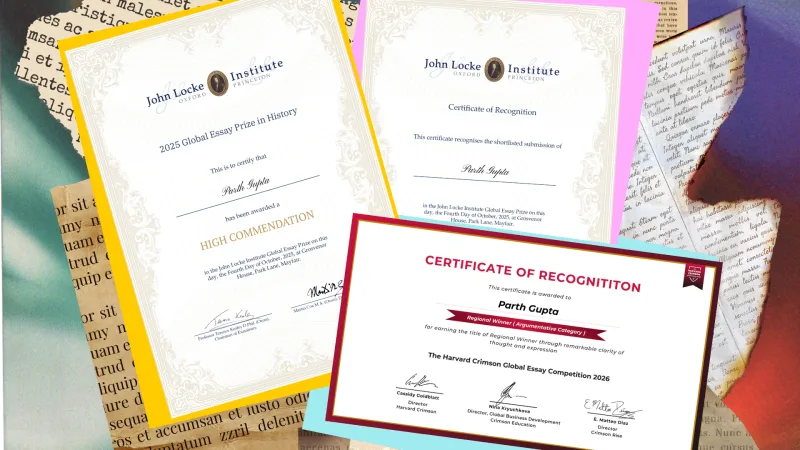
Competition certificates and recognition from six essay competitions

The John Locke Institute

4 submissions

One of the largest international essay competitions for pre-university students — a different category and prompt each time.

History CategoryHigh Commendation

The Architecture of Remembrance

How Pride, Shame, and Memory Shape National Identity

Written from the Sachsenhausen concentration camp memorial, where German teenagers inherit institutionalized shame as civic pedagogy. The essay compares that model against American exceptionalism (pride that immunizes against learning from failure) and India's decades-long "colonial victimization syndrome" — arguing both pride and shame are only justified when they serve future responsibility, not when they substitute for it.

"Shame that stops at contrition, pride that stops at mythology — these serve only our emotional needs while abandoning moral obligations to those harmed by our nations' actions."

Read the essay PDF · 10 pages
Economics CategoryRecognition

Saints Don't Exist. Neither Do Sinners.

Why the Profit vs. Altruism Debate Misses the Point

Opens with Lehman Brothers and Mother Teresa's charity failing within months of each other in 2008 — one collapse born of greed, one of supposed grace — to argue that the moral framing around profit and altruism is a distraction from the actual variable: whether competitive pressure and transparent incentives force any institution, private, public, or charitable, to answer to someone besides itself.

"Profit operates as a morally neutral force that amplifies whatever incentive structure contains it."

Read the essay PDF · 11 pages
International Relations CategoryAwaiting decision · Oct 2026

The Management of Compassion

Organised Sincerity and the Renaming of Obligation

Written against the prompt "Does foreign aid help or hurt poor people?" — opens with the 1943 Bengal famine and Britain's 1947 decision to call two centuries of colonial extraction "foreign aid" rather than reparations. The argument: aid's real function isn't poverty reduction, it's converting a claimant's right into a beneficiary's gratitude — and the system survives scrutiny precisely because the people administering it are sincere, not cynical.

"On 15 August 1947, a colonial power converted an obligation into a gift, and called the conversion generosity. The world has since administered that gift with such growing professionalism and conviction that the conversion is now complete. The debt has always been a gift."

Politics Category

The Diversity Dividend

Diversity is Fashionable, but is it Valuable? An Immigrant's Perspective

Written from being "too American for my Indian relatives, too Indian for my German classmates, and too German for my American friends" — argues diversity produces real, measurable economic and innovation gains, but only under specific conditions, and that "diversity washing" — loud commitments paired with unchanged leadership — is as real a failure mode as exclusion itself.

"The real question isn't whether we can afford diversity — it's whether we can afford to live without it."

Read the essay PDF · 11 pages

Regional & national competitions

2 submissions
USA Economics Olympiad · International Economics4th Nationally

The Price of Forgetting Power

How Comparative Advantage Built the World's Most Dangerous Dependencies

Opens with the fact that a single island's blockade could freeze the global AI industry, since one company fabricates roughly 90% of the world's leading-edge microchips. Argues Ricardo's model of comparative advantage has no conceptual mechanism for "weaponized interdependence" — so the same efficiency logic that built the modern semiconductor supply chain also built its single point of catastrophic failure.

"You cannot harvest the extreme benefits of hyper-specialization without simultaneously inheriting the catastrophic dependencies it creates."

Read the essay PDF · 12 pages
Harvard Crimson Global Essay Competition (HCGEC) · ArgumentativeRegional Winner · Europe & Central Asia

The Legitimacy Trap

How Voluntary Voting Distorts Democratic Mandates

Opens with Britain's Labour Party winning a parliamentary supermajority backed by roughly 20% of eligible voters. Argues voluntary voting doesn't protect freedom — it manufactures a legitimacy trap where strategic disengagement and quiet suppression decide outcomes more than persuasion does. The Australian model shows mandatory voting compels participation in the decision, not the decision itself — the same logic democracies already accept for jury duty.

"The ballot isn't a gift to be offered selectively. It's the foundation of legitimacy, and foundations don't hold if people aren't standing on them."

Read the essay PDF · 3 pages